Switching
Moving from Lightning to USB-C
Which Apple devices use USB-C now, what to do with Lightning accessories, what Apple’s USB-C to Lightning Adapter can and can’t do, and where the UK stands on common-charger rules.
Checked against sources 15 October 2026
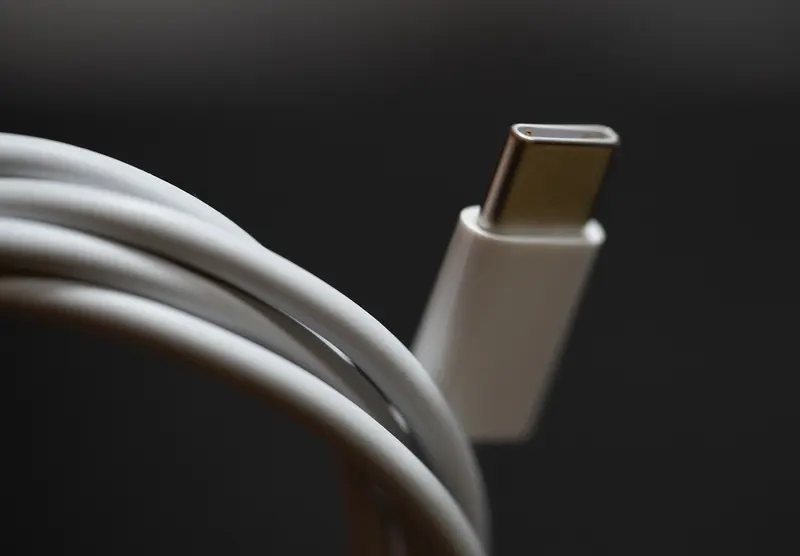
Who has USB-C now?
- iPhone: iPhone 15 and later. iPhone 14, the SE models and earlier use Lightning.
- iPad: every iPad Apple sells now, and many older ones. Apple’s list includes iPad Pro (M4 and M5), iPad Pro 11-inch (1st generation and later), iPad Pro 12.9-inch (3rd generation and later), iPad Air (4th generation and later), iPad mini (6th generation and later), iPad (10th generation) and iPad (A16). iPad (9th generation) is the last Lightning iPad here.
- AirPods: AirPods 4, AirPods 5 and the AirPods Pro 2 (USB-C) and Pro 3 cases have USB-C. AirPods 3, the 2022 AirPods Pro 2 case and the original AirPods Max use Lightning. AirPods Max came in a USB-C version in 2024.
- Mac keyboards and mice: Apple now sells Magic Keyboard, Magic Mouse and Magic Trackpad with USB-C.
Our device pages show the connector for every model.
Keeping your Lightning accessories
Apple’s USB-C to Lightning Adapter lets Lightning accessories, such as a car cable, a dock or wired headphones, work with a USB-C iPhone or iPad “for charging, data and audio”. Its limits, per Apple:
- Charging tops out at 24W. For faster charging, plug a USB-C cable straight in.
- Data runs at USB 2 speed (480Mb/s).
- Some combinations of adapter, cable and car can disrupt wired CarPlay. Apple suggests a direct USB-A to USB-C cable instead.
What USB-C adds on iPhone
- One cable for everything: Apple says USB-C iPhones charge from and connect to a Mac, an iPad, AirPods Pro 2 and later, and external storage.
- Charge small devices from your iPhone: iPhone 15 and later can charge AirPods, an Apple Watch or another small USB PD device at up to 4.5W.
- Faster transfers on Pro models: iPhone 15 Pro, 16 Pro, 17 Pro and 18 Pro support USB 3 at up to 10Gb/s. Apple notes that this needs a separate USB 3 cable, because the cable in the box is USB 2. iPhone Duo’s spec page also lists USB 3.
- Third-party cables: Apple warns that non-standard accessories may not work. Some third-party USB-C accessories and cables can even interfere with wireless connections.
Your shopping list for the switch
- A good USB-C to USB-C cable: 60W for charging, or USB 3 if you move big files. See cables.
- A USB-C PD charger with enough watts for your new device. See charging speeds.
- Apple’s USB-C to Lightning Adapter for the car or older accessories, or keep a USB-C to Lightning cable for older devices.
- If you’re on a newer iPhone, a MagSafe or Qi2 charger may mean fewer cables altogether.
UK rules
The EU’s common-charger rules have applied to phones, tablets, earbuds and more since 28 December 2024, and to laptops since 28 April 2026. In Great Britain, the government’s response to its call for evidence (published 15 October 2026) says it “does not intend to introduce common charger regulations in Great Britain at this time”. Respondents pointed out that the EU rules apply in Northern Ireland. In practice, Apple has moved its devices to USB-C anyway.
Sources checked 15 October 2026
- Apple Support – Charge and connect with the USB-C connector on your iPhone support.apple.com
- Apple Support – Charge and connect with the USB-C port on your iPad support.apple.com
- Apple Support – About the USB-C to Lightning Adapter support.apple.com
- Apple (UK) – USB-C to Lightning Adapter apple.com
- Apple Support – Identify your AirPods support.apple.com
- GOV.UK – Common charger for electrical devices: call for evidence gov.uk
- European Commission – The EU common charger single-market-economy.ec.europa.eu